Showing posts with label visual facilitation. Show all posts

Tuesday, March 02, 2010

Graeme Sacks snaps Roy in Killarney -- after Roy appeared on eNEWS CHANNEL live

Just bumped into @RoyBlumenthal doing his thing. Mugg & Bean ... on Twitpic

Graeme Sacks (@AfricanABC) popped into Mugg & Bean in Killarney. He took this pic of me demonstrating ArtRage to an interested-party.

I've been uploading pics I made live on-air this morning at eNEWS CHANNEL. They had a special to celebrate 100 Days To The World Cup, and I was invited to do on-the-spot visual facilitation of the event.

These are the pics I made:


Reblog this post [with Zemanta]

Monday, December 01, 2008

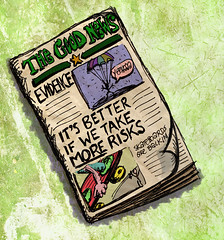
HOW TO LIVE DANGEROUSLY by Warwick Cairns -- a multimedia animated summary


HOW TO LIVE DANGEROUSLY is Warwick Cairns's second book. It's all about how the arbitrary 'safety' and 'health' laws imposed on us by 'the people who run things' are actually really bad for us. The book details strategies for taking back our power, and living better lives as a result.

This video is a multimedia summary of the book.

THE SCRIPTING PROCESS
I contacted Warwick with the idea. And he wrote a first draft script. I edited that, and sent it back to him for further revision. When he was happy that the script accurately represented the contents of his book, he made several voice recordings of the material.

SOUND DESIGN
I chose the best version, and started my sound design. I believe that the audio component of a movie supplies more than 70% of the power of a piece. As I do the sound design, ideas flow for the visuals. I wanted the soundtrack to be able to stand alone as an adio-only podcast, if Warwick wants to use it as such.
JAMENDO.COM & CREATIVE COMMONS
My starting point was to search http://www.jamendo.com/ for Creative Commons 'Attribution' or 'Attribution, Share-Alike' tracks. I specifically remove any track that specifies 'non-commercial' as one of the preconditions for using it. The two licenses I zone in on allow me to mold the music to my needs. With a hat tip to the musicians. In essence, I take their solid tracks, and sculpt them into what I need for the piece I have in mind.
For this type of work, I always search for heavy metal or hard rock first. I find that these genres offer the most energy and diversity of tracks. They almost always have killer bridges, with amazing musicianship. Really good raw material to work with.
I sourced several tracks from Jamendo. And brought them into Audacity, along with Warwick's vocal track. And I built the audio from there.
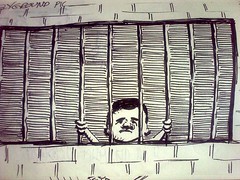
SKETCHES
In this piece, I sketched several pictures in my little Moleskine. All of these sketches were done in bed, with a copy of the script to hand. I did them in a sort of order, following the logic that Warwick and I created in the script.
My next task was to scan the pics, and work them in PhotoShop CS3. I coloured and textured the pics, squashed and squished them. And generally made them realllllly vivid. A few of those sketches didn't make it into the final film. But most of them did.
EDITING THE MOVIE
Next up was throwing the pics and sound design onto my timeline in Adobe Premiere Pro on my Toshiba Tecra M4 tablet pc.
THE CARICATURE OF WARWICK
While I was messing around in Premiere, editing, I took a break. I opened ArtRage on my Asus R1E tablet pc, started my video capture program, and made my caricature of Warwick in one short sitting. It took about ten minutes for me to get it to my satisfaction.
ANIMATING THE CARICATURE IN CRAZYTALK
I then opened CrazyTalk 5.0 on my Toshiba Tecra M4, popped the caricature in, dropped the voice-only track in, and got Warwick's pic talking nicely. When I was happy with the 'acting' of the avatar, I exported as a high res AV. That turned into a 5 gig file!
I slapped the animation movie into Premiere. And then followed tons of fanatical detail work. I originally intended painting speech bubbles for Warwick. But early on in the sound design, I decided to rather go for illustrative pics.
FLICKR & CREATIVE COMMONS
So I sourced suitable photos, using the Flickr Creative Commons search tool. I use the same criteria for pics as I do for music. The pieces HAVE TO be under 'Attribution', or 'Attribution, Share-Alike' licenses.
I found about twenty or so pics, and when trying them, found that most weren't reallllly what I wanted. Everything looks very different when the audio and video come together.
PICTURE AND MUSIC CREDITS
All of the picture and music credits are listed at the end of the movie, and here in the metadata...
MUSIC CREDITS:
  • "Drowned Devoured"
    by Outselling of Lies
    (Album: THE BEGINNING)
  • "Marchand de Bonheur" (nouvelle version)
    by Contreband
    (Album: À CONTRE PIED)
  • "Comercial de Verdade Verdadeira"
    by Jailson Brito Jr
    (Album: MATA BARATA)
  • "Dream Zero"
    by Marc Reeves
    (Album: LUCID DREAMSONGS)
All available from http://www.jamendo.com/.
All distributed under Creative Commons licenses.

PHOTO CREDITS:
THE FINISHED PRODUCT
This little vid took me about a week of solid work to crack. Deeply enjoyable for me. Warwick's publishers on both sides of the Atlantic (Britain and the US) are very keen to make use of the vid to promote the book.

CONTACT ME FOR YOUR VERY OWN ANIMATED SUMMARY
If you need any animated summaries made of any of your talks, get in touch with me. I work internationally, and I'm keen to see what I can produce for you. My email address is royblumenthal@gmail.com. My website is at http://snipurl.com/visualfacilitation.

Tuesday, November 18, 2008

Animated Rich...! Mulholland tells us about Missing Link


Rich...! Mulholland is the founder of Missing Link. (http://missinglink.co.za ) 

He appeared last Saturday on the television show I work on. I'm the inhouse visual facilitator for Kaleidoscope on CNBC AFRICA, making pictures of the ideas liberated by the interview process.

Because Rich...! was in an insert, the picture I made of him went unaired. So I figured I'd turn it into an animation. I smsed him a rough script, and asked him to send me voice files via email.

He tweaked them, and made them his own, and sent them to me. I did a sound design and audio edit, and then made the speech bubbles to fit.

This little video is the result.

The music is by a Russian heavy metal band that I found on my favourite Creative Commons site, Jamendo ( http://www.jamendo.com ). The band's name is МакЕнтош.
http://www.jamendo.com/en/artist/Artist_(3) . And the song is called "Сердце из камня, душа из металла". Download the full, unedited song for yourself -- it's terrific: http://www.jamendo.com/en/album/22041...

If you need any animated summaries made of any of your talks, get in touch with me. I work internationally, and I'm keen to see what I can produce for you. My email address is royblumenthal@gmail.com. My online gallery is at http://snipurl.com/visualfacilitation.

Painting: ArtRage 2.5 & Photoshop CS3. Animation: CrazyTalk 5.1 Pro. Audio Editing: Audacity. Video Editing: Adobe Premiere Pro
YouTube Tags: 

Friday, August 29, 2008

How to Go About Getting into Visual Facilitation

An ArtRage forum member sent me a message asking me how she could get into doing visual facilitation for a living. I figure my answer to her might be worth sharing. And maybe we can have some dialogue about my thoughts that might open it up and make it a bigger topic for us all.

Here's the main part of my letter to her (with pleasantries removed)...

---------------------------------------

Good to hear that there's another person interested in doing this! It's an absolutely awesome rush to do!

Okay... Fundamentals...
1. Are you well-read, well-versed in non-fiction, specifically business stuff, psychology, marketing? You'll need to pump up your knowledge in these fields.

2. Are you able to concentrate fiercely well for long stretches, listening ardently to new information, synthesising patterns from it, picking out fascinating details pertinent to the greater whole?

3. Can you multi-task? REALLY multi-task? When you're doing a visual facilitation, you're doing lots of things at once. I've described it to someone as 'flying a helicopter while holding two simultaneous, in-depth conversations'. I think I might revise that description and add a second helicopter to the mix.

4. How do you prefer to work -- traditional media or digital? This is a far-reaching fundamental choice. Sounds from your skill-set that you're digitally comfortable.

You haven't mentioned whether you use a tablet pc (or Wacom Cintiq), or if you're using a Wacom tablet?

Tablet PC is my preferred route. There are currently three machines in South Africa that I can recommend... Toshiba Portege M700, Asus R1E, Fujitsu T5010.

Portability of your setup is of paramount importance. Heading out to some remote conference centre should not induce muscle strain or back pain.

Working on traditional media limits what you can offer to your client. Most of the visual facilitators around the world use traditional media. I so so so don't recommend it. No edge. No instant distribution. However, if you MUST do it that way, go for it.

5. Are you willing to expose yourself to a roomful of people by making art live, before their very eyes?

I assure you, you are totally naked when your stuff is appearing live, in real time, on a huge screen next to the speaker's screen. They're watching your every move.

If you have ANY fear of public humiliation, you're going to find visual facilitation pretty hardcore.

If you're comfortable to do some really nice work on the odd occasion, with mostly clodhopper ATTEMPTS at brilliance most of the time, with people watching you frown as you hit the eraser button on ArtRage, then you'll thrive. It helps if you're an exhibitionistic showoff with immense amounts of self-confidence.


6. Are you happy to spend a lot of time doing free gigs for high profile audiences in order to establish a name for yourself? Do you have the chutzpah to inveigle yourself into events as 'the visual facilitator', even though you weren't invited, they've never heard of you, and you don't wanna pay the entrance fee? Do you have the ability to earn an income elsewhere to allow you to take a year to build this up into a business? Are you willing to learn and adapt what you're offering based on the gigs you do?

7. Do you have a winning, magnetic, persuasive personality?

8. Do you have the ability to look someone in the eye and say without shame or embarrassment or hesitation, 'I charge R12 500 per day for what I do.'? If you're blushing at the thought, convert that blush into a warm, fuzzy, delicious feeling of anticipated joy and liberation.

9. Are you comfortable with technology as a means of disseminating information about yourself? I use Twitter as my main communication tool in the world. I've been a blogger for about 6 years. I've had a website since the internet came to South Africa. I use Flickr as my primary portfolio tool. And so on.
Regarding the actual 'How' of your question, I recommend just sitting in on some event or other, and pushing yourself into doing a live visual facilitation without screening your work or standing out from the crowd in any way. Just draw what you hear. Get a feeling for how much work you need to do to be on top of things. Do more of these.

---------------------------------------

Do you have anything to add? Disagree with anything? Can you enhance anything?

I'm a visual facilitator. You can see some of my work online at http://snipurl.com/visualfacilitation. And my profile as a professional member of the Professional Speakers Association of Southern Africa is at http://snipurl.com/psasa-profile.

Thursday, August 14, 2008

'I believe I can fly!' -- starring Jacob 'Laduma' Zuma

Here's my latest little bit of messing around in CrazyTalk 5.1. This is a pic I made of Jacob 'Laduma' Zuma back when controversy hit him really hard. (Please don't confuse him with Zu-Ma Se Poes. Different politician.)

I'm experimenting with some ideas that Conrad Koch and I have been discussing. This is one of those experiments.

Tuesday, August 12, 2008

Using CrazyTalk 5.1 to Make a Talking Animated Self Portrait

Unbelievable.

I made a quick self portrait in ArtRage to test out my newly purchased piece of software -- CrazyTalk 5.1.
  • Opened CrazyTalk.
  • Imported the painting.
  • Placed the Mouth, Eyes, and Nose points.
  • Masked out the background with a single click.
  • Recorded a voice track.
  • Chose an emotion.
  • Published.

The entire process took less than five minutes. And the little 30 second vid below is just the tip of the iceberg. There's so much more I can do with the software.

Suffice to say that I'll be finding a way to incorporate this into my visual facilitation practice.

The little speech bubble containing the link to my visual facilitation portfolio online is something new to YouTube -- video annotations. You can place them wherever you want in a video. Also amazing. Very useful. Makes YouTube a very good teaching tool.

Sunday, August 03, 2008

27 Dinners Jozi -- How Can Speakers Be More Engaging, Audiences Better Behaved, and Everybody Happier?

This is a slightly edited version of a comment I've left on a blogpost on MORALFIBRE: http://www.moralfibre.co.za/?p=262#comment-19

In the post, Vince talks about his experience of the last 27 DINNERS (http://27dinner.com/) evening, at which I did the visual facilitation and live-blogging. Several people have responded in the comments to some of the less-than-desirable elements of the evening. (Luckily, my visual facilitation seems to have been well-received. Phshew!)

The stuff I'm talking about below pretty much all comes from my own experience as a speaker, standup poetry performer, street performer, salesperson, and corporate communications practitioner. I know that some of what I have to say might seem a little blunt, and possibly a tad harsh, and might make me a bit unpopular. At the same time, this stuff does need to be said.
Roy Blumenthal, the visual facilitator here.
THE IRRITATING AMERICAN
If I'm not mistaken, the 'irritating American' was Brian Carl Brown, Chief Operating Officer of http://www.bluecatalyst.co.za/. Are we talking about the guy who spoke about the golf day that noone wanted to attend??? If so, then yeah... Brian Carl Brown's yer man.

His colleague came up to me while I was wrapping up my drawing and live-blogging of the event, and proposed that Blue Catalyst and I might do some business together. I thought it would be a good idea. And we agreed to have talks about talks.

Shortly after the chat, Brian cannon-balled up to me, and announced, 'I think my colleague might not have gotten the point across. We're an NGO, and we don't have big budgets for our events, which are free.' Blah blah blah, poverty, blah blah, etcetera. 'So actually, we can't afford to pay you R8500 for a half-day's visual facilitation, or R12500 for a full-day. We haven't got money to pay you for the freebies. But if you do those, we might be able to get you some paying gigs. You get my drift?'

At that point, I was no longer listening. I work for a living. And the guy's attitude was actually pretty sucky. (But I think the presence of alcohol at events like this is a MAJOR contributor to the crapheadedness of some of the people present.)

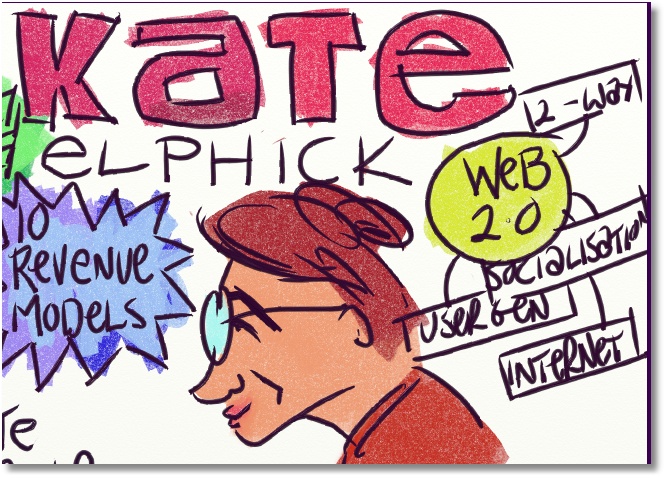
KATE ELPHICK'S TALK
Kate... You really really really really need to take a look at Garr Reynolds's site, PRESENTATION ZEN. Seriously. http://presentationzen.com/.
  • One concept.
  • One slide.
  • One picture.
  • No words, or VERY few words. Three or four words max.
  • Your slide is a billboard for an idea.

  • It's not an academic treatise to be read and mulled over.

  • A presentation is real-time.

  • It gives people the argument, supported by the facts.
Your presentation was very dense, and difficult to follow, for me.

I was also pretty alarmed at what I assume MUST have been my mishearing a stat your quoted. I THINK you said that the average black South African attends two funerals a week. If that's the case, I REALLY have to see your sources. And you really need to quote those sources. And you need to qualify what that stat actually means. I'm surrounded by some fairly average black South Africans, and, anecdotally evidenced, they absolutely DO NOT attend even two funerals a MONTH. let alone a week.

Re the cultural bias of the audience... hmmmm.... nope. GONG. That's spurious. Your presentation needs to be targeted at the people you're talking to. So if you're talking to an audience of whitey business people, you'd best find the argument that speaks to those people. Show the business-types video footage of the amazing response you're claiming your black audiences give you. Deliver on your premise.

I support Vince's reading of your argument. I feel you're making several untested and unsupported assumptions, and you're really not making that argument 'come to life'. (Yeah... pun intended.)

JASON HOBBS AND INTERFACE DESIGN
I like Jason. I know him in the real world. But I don't think his preso cut it.

It started promisingly, with some really cool, simple, single-minded, focused slides, that we pretty much pictures illustrating a single point he was making. From around his third slide, the discipline disappeared. And he fell into the trap of cramming way too much stuff onto the slide, with almost NO logic to how things connected.

A presenter must NEVER have to apologise for the contents of their presentation being unreadable. Dammit. Those slides that he kept apologising for would have been unreadable in a pitch-black room on a high definition television screen. If you can't read your own slide on your computer screen, how the hell are we going to see it on a pasty big screen?

Jason also fell into the trap of telling us WAY too much about his topic. He brain-dumped his knowledge on us. And used ultra-lame examples to ground it. Google and iPhone are NOT great examples of UI. They are great examples of very specific points about UI.

Hone it down, dude. Choose ONE topic, and tell us about that.
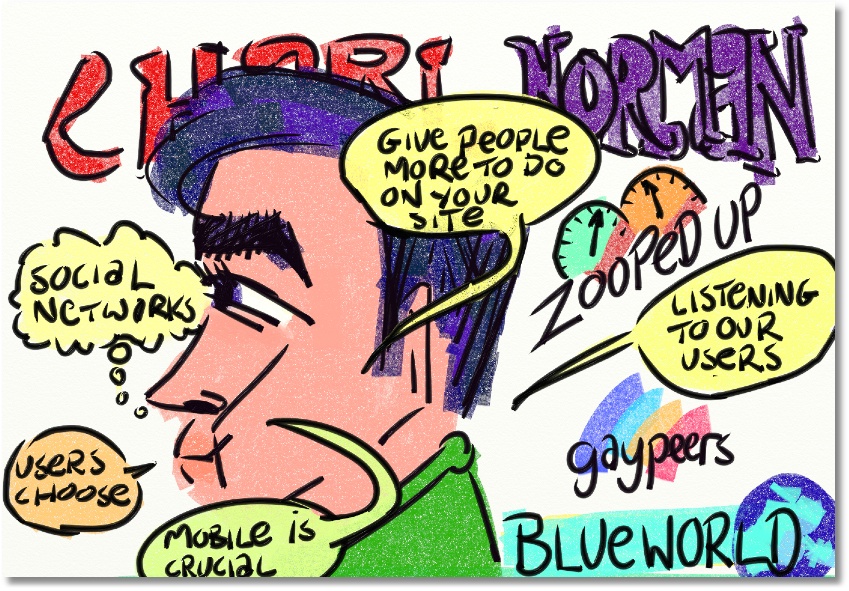
CHARL NORMAN, BLUEWORLD (http://www.blueworld.co.za/)
Charl has stated in tweets and elsewhere that he felt his presentation was weak.

I think he's probably being a tad hard on himself. For me, his talk was passionate, engaging, real, and grounded. I felt that he was sharing his thoughts with me as a conversation partner. He wasn't brain-dumping. He wasn't spewing facts and figures. He wasn't making unsupported arguments.

What he WAS doing was putting his expertise and experience on the table, and inviting others to share in his interpretation of his own successes.
Case study stuff.
Very nicely done.

MICROPHONE TECHNIQUE
One thing ALL of the presenters can learn about is microphone technique.
Here are the rules:
1. ALWAYS do a sound check. ALWAYS. Do NOT simply grab the mic and try to be audible. Every mic requires a specific approach to getting the best sound out of it. Did anyone else feel their ears disintegrating at the plosive 'p' sounds cranking out at full volume? That's avoidable. And easy to deal with.

2. NEVER tell an audience that you don't like using microphones. CHARL! We're there to HEAR you. Make it a JOY for us. We're not interested in your discomfort. And we're not interested in excuses. You HAVE something valuable to say. So embrace the platform, and do it.

3. Most microphones can be dealt with in one of two ways. EITHER put the mic in your hand with your fingers curled up just below the ball of the mic. Then extend your thumb out, and place it on your chin. This puts the mic directly in front of your bottom lip, an inch or so away from the pop-cap. MOST mics work best like this. Keeping your thumb extended in this way keeps the mic in position, and reminds you that you're talking to an audience who are hanging on your every word.

OR, put the mic ON your cheek, touching the corner of your mouth. Yes... that part of your mouth that gets little white spit flecks when you get old. Angle it slightly towards your lips, and keep it pressed to your skin. This only works for some mics. But when it works, it completely removes plosive pops.

4. PROJECT, people. Just cos you've got a mic doesn't mean you can talk like someone with emphysema. Projecting comes from working your diaphragm. Go for voice lessons if you can't get your voice to carry to the other end of a boardroom. And speak into the microphone with booming clarity, enunciation, and conviction.

THE NOISY CROWDS AND DRUNK ASSHOLES
Mike... this is directed towards you as the Joburg dude.

The organiser of an event needs to control the event. You must not be embarrassed to tell obnoxious winos to shut the fuck up. It's NOT acceptable for speakers to be whooped at. It's not acceptable for drunk Americans to hog the mic for a golf-day that geeks aren't interested in. It's not acceptable for a venue to allow a rowdie party upstairs to noise-out a gig. It's the organiser's duty to deal with these things. Throw people out if you have to. Call a halt to proceedings until things are sorted.

Speakers... YOU have a duty to pause in your talk if the conditions make it impossible to be heard. BUT... you also have a duty to make sure that your talk is fascinating and captivating. SOMETIMES people fidget and chat because the content and/or delivery of your talk is crap. Face this as a fact. Of course, sometimes, it's just the presence of a loud-mouthed drunkard overpowering an otherwise appreciative audience. Don't get so caught up in trying to deliver your message that you fail to see what's happening.

Desperation in a speaker is contagious. And becomes disastrous quite quickly. Learn how to deal with interruptions. Read up on heckling, and how standup comics deal with it. If you don't, you're letting yourself down. More importantly, you're letting your audience down.
STORMHOEK
Ban alcohol at business networking events.

Seriously.
The number of puke-smelling breaths that blasted into my face as people leered over my shoulder into my tablet-pc all merges into a nightmare swamp of inebriated dumbfuckery.

I have nothing against people getting plastered on their own terms, in their own environment. But when they're attending a geek dinner, aimed at helping them expand their circle of acquaintances, I'd really ask them to question their methods if those methods include quaffing industrial quantities of free wine.

What's the deal? Are they so poor they can't afford their OWN wine? Are they so low on self-esteem that the only way they can derive enough bravery to speak to another person is if they're falling down with pissedness?

Ask yourself this: If YOU were blasting YOUR wine-fumes (vomit-smell, by the way) into someone's face, would you expect them to take you seriously as a business contact? If so... drink away. But stay away from me. If not... then decline the refill of the Stormhoek blogging sensation.
I wonder if the zero-pricing of the event isn't building in an ethos of 'I'm here for myself only, and there are no consequences to me acting like an ass-wad, and I'd love to guzzle eight litres of free Stormhoek plonk, and I'll make a noise if I wanna, and I'll grab the mic when I can'?

Maybe if people were paying for the event, they'd take the speakers more seriously?

What if people were able to get a sliding scale refund based on the crapness of the speakers?
If all three speakers are collectively voted as crap by the audience, then they get a full refund.
And speakers get a cut of the proceedings, so that they are incentivised to deliver great material. (They can give those proceedings to a charity, if they're not in it for the bucks.)

I've been to two 27 Dinners now. Jon Foster Pedley's was the first, and he had the discipline of using Pecha Kucha (http://www.pecha-kucha.org/) as the basis of his preso. And that made it work really powerfully for the audience. This past one also worked for me, but only cos I was working overtime at trying to pull out salient bits in my visual facilitation. I think if I'd been a member of the audience, the only talk I would have paid attention to would have been Charl Norman's. The other two were simply not gripping enough, and not polished enough, and didn't contain enough of an argument to be compelling.

Monday, July 28, 2008

Live Visual Facilitation Coverage of the 27 Dinners Jozi Chat -- Mon 28 July 2008


If you're one of the people who can't make it to 27 Dinners tonight, I'll be doing a live visual facilitation of the event, along with live-blogging of the pics I make.

If anyone wants to write commentary, please contact me on http://twitter.com/royblumenthal or royblumenthal@gmail.com, and I'll add you as a producer on my CoverItLive console. (You need to be running Firefox 2.* or Internet Explorer for the console to work on your machine.)

This live blog is my first public run using CoverItLive. So please join in and leave comments. It'll be great to hear from you.


If you'd like to hire me to cover any of your events, I'd be happy to chat about what I can offer.

You can take a look at my profile as a Professional member of PSASA, the Professional Speakers Association of Southern Africa. It's at http://snipurl.com/psasa-profile.

My online portfolio is at: http://snipurl.com/visualfacilitation.

Monday, April 07, 2008

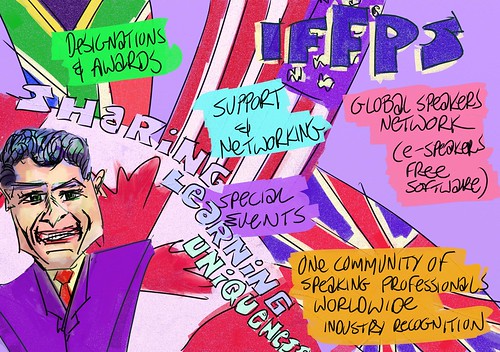
Roy Blumenthal does a visual facilitation for top international speakers at the NSASA Convention 2008

Welcome to Roy Blumenthal's visual facilitation pictures made during the NSASA Convention 2008, at the Sibaya Convention Centre near Durban.

Roy Blumenthal is a Professional Member of the Johannesburg chapter of the National Speakers Association of Southern Africa. View his NSASA profile page at http://snipurl.com/nsasaprofile, and consider hiring him to create a memorable record of your next event.

After observing and being on the receiving end of Roy in action during the conference, Joe Sherren, President of the International Federation for Professional Speakers, sent this email to Roy:

"I just wanted to write and say what an amazing job you did at the NSASA Convention in Durban. Your artistic and creative talents are absolutely amazing. You added to the enjoyment of all the presentations and your work will leave a timeless memory for every attendee. I hope we can work together again in the future."

Here are the pictures Roy made live during the event. He had his computer hooked up to a video projector. So every painting was screened to every member of the audience.

The National Speakers Association of Southern Africa has a convention every year. This year -- 2008 -- it was held at Sibaya Convention Centre near Durban, South Africa

The three-day programme was crammed with top-notch, high-level speakers. And that's just the audience members!

On the podium were the cream of the crop of both local and international speakers.

Roy sat in the room with his trusty tablet pc attached to a video projector. Each session, he paid serious attention to what was being said, and painted his interpretation of the ideas being delivered.

His role is to supplement the speakers, not to overshadow them. He says, 'I try to gauge the tenor of the speaker's talk, and angle my pictures towards their particular personal style of delivery.'

Barry Holley, a South African training expert attending the convention, said, 'Roy's work is non-intrusive, non-distracting, supportive of the speaker's message, and a good reminder.' He added, 'Roy makes it very easy for audience members to assimilate the material. And his pictures are a great memory jogger after the event.'

Roy is excited at the response to his work. 'It's making me very happy that people in the room appreciate what I'm doing,' he said. 'This is an unbelievably exacting audience to work for. Almost every single one of the people here speaks professionally for a living. And they've seen every trick in the book. When they tell me they love what I'm doing, and that they can see themselves working with me, that tells me that I've been doing something right.'

Something else suggests that his efforts were appreciated. 'I brought about a thousand business cards with me, and I've got fewer than half left.'

But business cards don't tell the whole story.

Britain's media training specialist, Alan Stevens, had never worked in this way before. Initially, when Roy was introduced to him, he was reluctant to have Roy's visuals on the screen behind him. 'Oh, what the heck. I'll give it a try,' he said. When he came off the stage, he was beaming. He went over to Roy and said, 'I'm a convert. I'm really glad you were doing that behind me, Roy. Thank you.'

Another British speaker, 'Walking Tall' style-guru, Lesley Everett, said, 'You really added to the event.'

Kristin Arnold, President of the USA and Canadian company, The Extraordinary Team, was another speaker at the conference. Roy and Kristin worked together to help emphasise specific points. 'I have a background in advertising, and corporate communications. I'm also a trained crisis counsellor. This means that I'm very attuned to what people are trying to convey. So I can work pretty intuitively. When Kristin briefed me on what she wanted, I was able to grasp her objective quickly.'

Kristin, who traditionally doesn't use Powerpoint in her presentations, said afterwards, 'I've never worked with a visual facilitator live. Roy provides a way to seamlessly integrate visuals with a presentation.' She said, 'While I'm describing or explaining something, Roy is reinforcing my message.'

When asked to describe his offering in one paragraph, Roy said, 'My visuals help speakers and trainers to bring their message alive in a rich, colourful, interactive way. The hero of the day is the message, and I'm there to support the speaker in delivering that brilliantly.'

Because Roy works digitally, using a tablet pc running specialised art-making software, the paintings he makes are instantly available for distribution to delegates. 'One of my clients has printed A1 posters of my pictures,' said Roy.

Ben Zander, speaker, co-author of THE ART OF POSSIBILITY, and conductor of the Boston Philharmonic Orchestra, has used Roy's graphics on his website.

'People can print them out as handouts, or use them as emails,' Roy says.

All of the pictures here are available for free download, and may be used for whatever purposes you see fit, within the boundaries of the Creative Commons License Roy releases all of his work under.

Please take a look at the title deed: Creative Commons -- Attribution, Share-Alike.

Roy says, 'Thank you to everyone for allowing me to make a difference in the room.'

Book Roy today. Call him on +27 74 104 6386. Or email royblumenthal@gmail.com

A Note From Roy Blumenthal:

All of the paintings in this group are made live, on the fly, in the room, while the speaker is delivering his or her address. I currently use a Toshiba Tecra M4 tablet pc, running ArtRage 2.5 painting software.

I am a professional member of the National Speakers Association of Southern Africa. You can view my profile at http://snipurl.com/roy--nsasa.

I am available for international gigs. Please email me on royblumenthal@gmail.com or call me on my mobile: +27 74 104 6386 to book me.

Wednesday, January 16, 2008

2008-01-16 Welcome to Your New Classroom With Jennifer

Yesterday I helped Jennifer set up her classroom. I installed some shelves for the kids to pop their shoes into. And I also did a little drawing of Jennifer on the whiteboard.

I took a few snapshots of it with my Nokia N91 phone camera. And then transferred them to my computer.

Then Photoshop CS2 came into play in a big way to sharpen the images, and reconfigure the elements into a more pleasing composition. (More pleasing to me, that is.)

And of course, colouring and texturing.

I've made this pic for Jennifer to print on canvas and use every year as a banner to hang in her room.

(The name tag I made for her was an absolute hit. Kids and parents loved it. Colleagues were a little put out, because most of them insist on being called 'Mister' and 'Missus', rather than by their first names.)

I did the linework for this pic using eraseable whiteboard markers on a white surface in Jen's class. I took photos with my Nokia N91. And worked extensively on the images in Photoshop CS2. All on my Toshiba Tecra M4 tablet pc.

Monday, January 14, 2008

My new Flickr profile -- I'm available to do visual facilitation work for you


I'm a Visual Facilitator, also known as a Graphic Facilitator.


Imagine a workshop or seminar. Sitting in the corner is an artist with an easel. That artist is visually interpreting the ideas that are flying around the room. That artist is me.

I work on my Toshiba Tecra M4 tablet pc, painting primarily in ArtRage 2.5, with a video projector hooked up to my machine so that people can see what I'm painting.

At the end of the session, everyone gets to take home the pictures I've made.

Here's a link to my Flickr set showing some of my work: Visual Facilitation.

I'm happy to work anywhere in the world, with the proviso that I have fair notice to sort out visas where necessary.

I charge R8 500 (roughly US$1300, Euro 850, UK£650) for a half-day session, and R12 500 (roughly US$1 900, Euro 1 250, UK£950) for a full-day session. This excludes travel and accommodation.

Coffee-Shops and Me

I'm a coffee-shop schmuck, and I spend much of my time sketching people in coffee-shops. I'm somewhat of a leftie (probably more of a left libertarian than anything) and a sometime activist.

My Motto

I live my art in prosperity and abundance.

Technical Details

All of the earlier drawings are done directly onto an iPAQ 2210 palmtop computer, running a licensed version of Mobile Atelier drawing software. These pics are NOT suitable for artprints, except small, cos their resolution is only 320 x 240 pixels. I'm VERY happy to print them out as postcards for you. Lemme know, and I'll do it.

The later, more detailed, higher-resolution drawings are done on my Toshiba Tecra M4 tablet pc, running ArtRage 2.5, Alias Sketchbook Pro 2.0, Corel Painter 9.5, and Photoshop CS2. Almost every painting I make now is done in ArtRage.

(Sandi asked me if I get paid for mentioning ArtRage and Toshiba. The answer is a resounding no. I get nothing from those companies. No favours. No freebies. No money. No nothing. I just love what their tech does for me.)

I generally draw the line work on the top layer first, and then I colour on the layer below that. Each painting takes between 60 and 240 minutes to make, the colouring taking most of the time.

Creative Commons -- Attribution, Share-Alike

I'm a great believer in the open source movement. That's why I release all of my artworks under a Creative Commons 'attribution, share-alike' license.

(It's also why I buy music from Magnatune.com.)

My license means that you're free to use my work as you see fit, as long as I'm credited, and you distribute your work under the same license.

Swaps of Prints

I love doing swaps with other photographers and artists around the world. If there's a pic of mine you like, and I like one of yours, let's swap. Here's the deal... I give you a signed print, you give me a signed print. That way we both win.

Here's my postal address...

Roy Blumenthal
PO Box 532
Auckland Park
2006
South Africa


My Blog

I'm a fairly regular blogger, with a tiny cult following which seems to be shrinking since I stopped talking explicitly about BDSM and sex. Hehehehehe. That's in the archives. You can find me at: schmucknews.blogspot.com.

My Stuff on Zazzle

I'm now selling my artworks on various items at Zazzle. They're an official Flickr associate, so give it a try!

My Prickie.com Button Shop

I have a button shop-front on Prickie.com. I supply the designs, they print, manufacture, and ship the buttons. I get an incredible US75c per button sold!! So make me rich! Go and buy my buttons.

Please note that one of my absolute aims is to offend people. So if you're NOT offended by my lapel badges, please let me know what I'm doing wrong!!!

Here's the address of my shop-front: ACoffeeShopSchmuck Button Shop.

Where to Find Me

Twitter: royblumenthal
Facebook: Roy Blumenthal
Skype: royblumenthal
Google Talk: schmucknews@gmail.com
Shared Google Reader Links: schmucknews
Cellphone: +27 74 104 6386. (That '+27' is the country code. Pop that number into your cellphone as it stands, and it should get to me.)
Email: schmucknews@gmail.com

Tuesday, September 25, 2007

Using a tablet pc to make art

This is a recent post of mine on the ArtRage Tips and Tricks forum...

Here's my solution to the tablet pc angle conundrum...


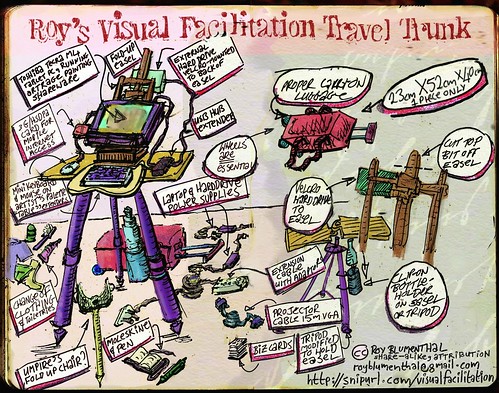
In this pic, you see it configured for use on a tripod. That's why I have the artist's palette slotted in at the front. Normally when I'm at my desk, I don't slot the palette in. But the keyboard and mouse are standard accompanying dishes.


The tablet all alone on the easel is a bit lacking. I find that I need the keyboard for ArtRage keyboard shortcuts. And for easy entry of file names. Tablet entry works, but it takes too much time under pressure. The mouse is useful for navigating around outside of ArtRage. Things like web pages and such.


Here's a look at the two items side-by-side, showing the tablet in laptop mode, and the easel waiting for inspiration to strike.


I've sawn bits and pieces off the easel, simply to make it fit in my bag for when I fly to Visual Facilitation gigs. (http://snipurl.com/visualfacilitation)

I find that this configuration really suits my needs. And because it's all adjustable, it's very friendly on the neck and back.

If you look for a table easel, I would suggest good art shops. I've seen similar ones to these at Herbert Evans in Joburg. And I got mine from a fleamarket -- the Rosebank Fleamarket, to be precise.

Things to look out for...

o It needs to be portable, and therefore, foldable flat.

o It needs to have sticky-outy-bits that can be sawn off to save space.

o The BACK sticky outy bits need to be fairly long, specifically for when you have your angle closer to horizontal than vertical... the centre of gravity takes over at that point. DON'T saw them off! And be sure to test it with your tablet pc BEFORE you purchase or saw anything.

o Light and small are your friend if you're lugging these things around to coffee shops and onto planes like I do.

Intense 'crash test' -- ArtRage survives -- with some tweaks

Here's a post I recently offered to the ArtRage feedback forum...

I recently stumbled into becoming a visual facilitator. It's a field that requires real-time live capturing of people's ideas in a meeting or seminar.

The visual facilitator basically sits in the room capturing the content of the session, interpreting it visually.

Some visual facilitators use traditional art-making tools. I use my tablet pc, with ArtRage 2.5, with a video projector hooked to my machine, displaying my stuff in-progress on the back wall of the venue.


I have now done four sessions, two of them for money. And I can tell you, it's a pretty intense way to spend a coupla hours. Relentless. Hard hard hard work. And ArtRage is really tested to the limits.

Here are my responses to the package:

1. Freaking excellent!!!!! It works like a bomb! And I am SO happy to have discovered this package. ArtRage... you are the ultimate!

2. I see people's jaws hanging open in amazement as they crane their necks round, watching the screen, then watching me. They LOVE what they see.

3. Because of my ability to make incredible pics using ArtRage, the work is really just flooding in. From 0 to 100 in seconds, actually. Brilliant. Thanks, ArtRage.


Here's my working setup:

1. I'm using a pretty underpowered tablet -- the Toshiba Tecra M4, with 1.73gHz single core Centrino processor, 1 gig of ram, a 60gig onboard harddrive, and a 160gig USB2 external harddrive.

2. I have ArtRage 2.5.1.6 open at all times. Possibly two or even three instances of it. Cos sometimes I have to prepare a picture that will be used later in a session. And I need that open so I can flick back and forth at will.

3. I have Firefox open at all times, along with a 3G dashboard, allowing me constant mobile web access to be able to hunt for and download reference images as needed. Firefox is a memory slut. And it consumes WAY too much of my processor power for my liking. I'm thinking I'm going to have to reconsider the Firefox side of things.

4. I have Bluetooth switched on all of the time, cos my current easel means I don't have access to the switch. I take reference pics of speakers using my cellphone, bluetooth them across, and import them into ArtRage. Another bit of memory hogging.

5. In ArtRage, I have a few high res templates set up. These have a base layer of metallic coloured paper with a custom texture. I also have two images on separate layers acting as filters. One sits just above the base layer, adding colour and tone to the canvas. The other sits right at the very top level, and stays there, adding colour and texture to the painting layers I'm doing. Both of these layers have blending turned on. A memory hog, I suspect? I need this because I'm working live. My images are projected onto the back screen, so people are seeing it as it happens. I can't wait till the end of a pic to apply the blends and so on.

6. My images are fairly high res. Cos my clients all want to be able to print the final pics out at A0 size. Which means I'm working at 3508 x 2479. (This is a PowerPoint aspect ratio, cos I also have to save pics to memory stick for presenters to slap onto their own PowerPoint presentations.)


Now, let's look at some of the things that I've observed in terms of performance:

1. ArtRage is very slow in switching from layer to layer. It's ULTRA slow in applying blending options. If I had a more powerful machine, I would have Photoshop open all the time, and slap an image there to experiment with blending. But I can't. So I HAVE to use ArtRage. But it takes WAYYYYYY too long. Two things that need fixing... a. I need to be able to use the down and up arrows to go through each blending option. b. I need blending to be fast. Ultra fast. As fast as Photoshop. In fact, I need ArtRage to give me the option of using Photoshop's blending engine, instead of the built-in one. At least, that's what I THINK I need. What I reallllllly need is speed. Tons of it.

2. Exporting to Photoshop is too slow. I would prefer to be able to allow ArtRage to give me the option of saving ALL files as Photoshop native, rather than ArtRage. This would allow me to hit save (cutting out steps in between), close ArtRage, open Photoshop, do whatever I need to do in Photoshop, close it, and immediately open ArtRage again. With no intervening steps. Those steps add minutes to any swap. I don't HAVE those minutes in a visual facilitation scenario. It's time pressure like I've never dealt with before.

3. The 'transform layer' tool is brilliant. But the interface isn't friendly to this time-crushed practitioner. And it's WAY WAY WAY WAY WAY too slow. I would so prefer the traditional Photoshop/Corel interface... the marque with arrows on the corners. And it HAS to work faster. It takes around 20 seconds for me to resize a pic. Another twenty to see a rotation. Etcetera. This is one of those areas where I wish I could flip seamlessly between ArtRage and Photoshop. Photoshop is super fast at this stuff. ArtRage is super slow.

4. There is no tool in any package I've worked on to date that beats the ArtRage palette knife. Having said that, the palette knife in the 2.2 version gave me way better results. The new version doesn't offer me a tool that does the same thing. I realllllllllllly want the old tool back. It was way better for what I need. In one of the modes, it also behaves really slowly. I make a stroke, and it takes a good twenty seconds to show progress of the stroke.

5. I neeeeeeeed neeeeeeed neeeeeeeeeeeeeeeeeed to see the full file name on screen at all times. It HAS to appear somewhere. This is something I actually can't do without. When I'm working hard and fast, cranking out six to ten paintings in a 3.5 hour period, I HAVE to know which file I'm on. Or I risk painting over one of the sessions I've done. This is critical. It's a red flag update, for me.

6. I spontaneously create multiple layers. Cos I'm capturing stuff in real time, I often paint something too big, and need to resize it later. Then capture the next thing on another layer, and resize that later. Which means that I end up with, say, six layers, that will ultimately become one layer. I would like to be able to do as in Photoshop.... select ALL SIX layers, and merge them down to one layer in one operation. The layer merge tool is ultra slow in ArtRage, and needs some attention, I feel.

7. One of my key needs for flipping between Photoshop and ArtRage is to move components around, getting the layout and design of my incredibly fast sketching into shape. ArtRage offers me no fast way of doing this. Photoshop does. But the two just don't see eye to eye fast enough for me.

8. Please bring back the space bar for moving the canvas around. I need it. The right click is faulty in two significant ways... a. It has a significant lag on it. b. Whatever tool I'm on when I press the right button to drag is active for a split second. When I'm erasing, for instance, there will be a single LEFT click that somehow happens on the erase tool as it engages with the drag. So a hole is left in the surface I'm moving. Same happens with the magnifying tool, the roller, and the brush. This has to be fixed. Both by fixing the right click functionality. AND in bringing the space bar back as the moving tool.

9. There is a significant tool-engagement error, that reallllllly irritates. It happens like this. I'll click, say, the magnifying glass, and start enlarging the screen. But because of the lag, the magnifying glass doesn't engage, and it stays on the tool I was on. So, if that was a brush, I'll end up with a streak of paint across the screen. It it was an eraser, I'll erase a swadge across the screen. When I'm painting, and I lift the brush, putting it down often doesn't engage the brush. It kind of seems to require TWO clicks. The first click makes it neutral. The second click engages the brush again. This didn't happen in 2.2. It's happened in all of the 2.5 versions so far. I really hope I'm explaining this one correctly.


Thank you, ArtRage and ArtRage-makers:

Having said all of this, I really want you to know that I LOVE ArtRage. And I've simply gone into clinical detail about these things cos I can. Cos I've tested it under seriously hardcore conditions. And if you look at my Flickr gallery of images created under these conditions, you'll see that ArtRage shines. http://snipurl.com/visualfacilitation.

Thursday, September 06, 2007

Roy's Visual Facilitation -- a one-sheet of what's on offer


Roy's Visual Facilitation -- a one-sheet of what's on offer, originally uploaded by royblumenthal.


Having recently come across the field of 'visual facilitation', I'm striding headlong into this as a way of earning my living.

This is a quick read for people to get a sense of what it is I do. It's little more than a skim overview. But hopefully it arouses some curiosity.

From the top, the interventions I've used are:

o John Tschohl (www.johntschohl.com).

o Benjamin Zander (www.benjaminzander.com). He wrote to me and said...

I've been so busy [...] that i haven't written to acknowledge
your beautiful drawing/painting. It captured the spirit (and quite a
lot of the content) of the event and I will treasure it. In fact, it
is on my website.

Thanks so much for pouring your heart (and hand) into The Art of
Possibility. What a blast we had that day!

Warmest greetings

'till the next time we meet in SA

Ben


o Then the speaking buffalo is John Tschohl again.

o With Paul Macleish from Achieve Leadership representing the Disney Insitute in the bottom left corner (www.achieveleadership.net).

o And Mickey Mouse in STEAMBOAT WILLIE taking the bottom right corner by storm.

o Below the box is me, in a self-portrait.

I've already got three potential clients coming up soon, and I'm looking forward to this tremendously.

This sheet is designed to print clearly as an A4. Which means that you'll probably need to view it big to be able to make any kind of sense out of it.

This pic was made using paintings done in ArtRage on my Toshiba Tecra M4 tablet pc. I hacked things together using Photoshop CS2, CorelDraw 10, ArtRage 2.5, and my HP F380 Scanner/Printer.

Tuesday, August 07, 2007

2007-08-07 Ben Zander at Jeppe Girls High

This afternoon I attended a talk by Benjamin Zander at Jeppe Girls High. I took my computer and easel with, and thought I'd do a visual summary of the session. This is the result.

Benjamin Zander is co-author (with his wife, Rosamund Stone Zander) of the book, THE ART OF POSSIBILITY. It's a must-read. A must-live.

Check him out on www.benjaminzander.com.

And if he's ever in your part of town giving a talk or conducting an orchestra (or even a string quartet as he did this afternoon), be sure to catch his talk. He's a lovely dude. With a lovely attitude. And he's infectious. In a good way.

This painting was made on my Toshiba Tecra M4 tablet pc as an exercise in Visual Facilitation. I used ArtRage 2.5 to do the painting, and Photoshop CS2 to do the tweaking. And Ben signed my book. Yay!!!

UPDATE: Ben has included the pic on his website.

ShareThis